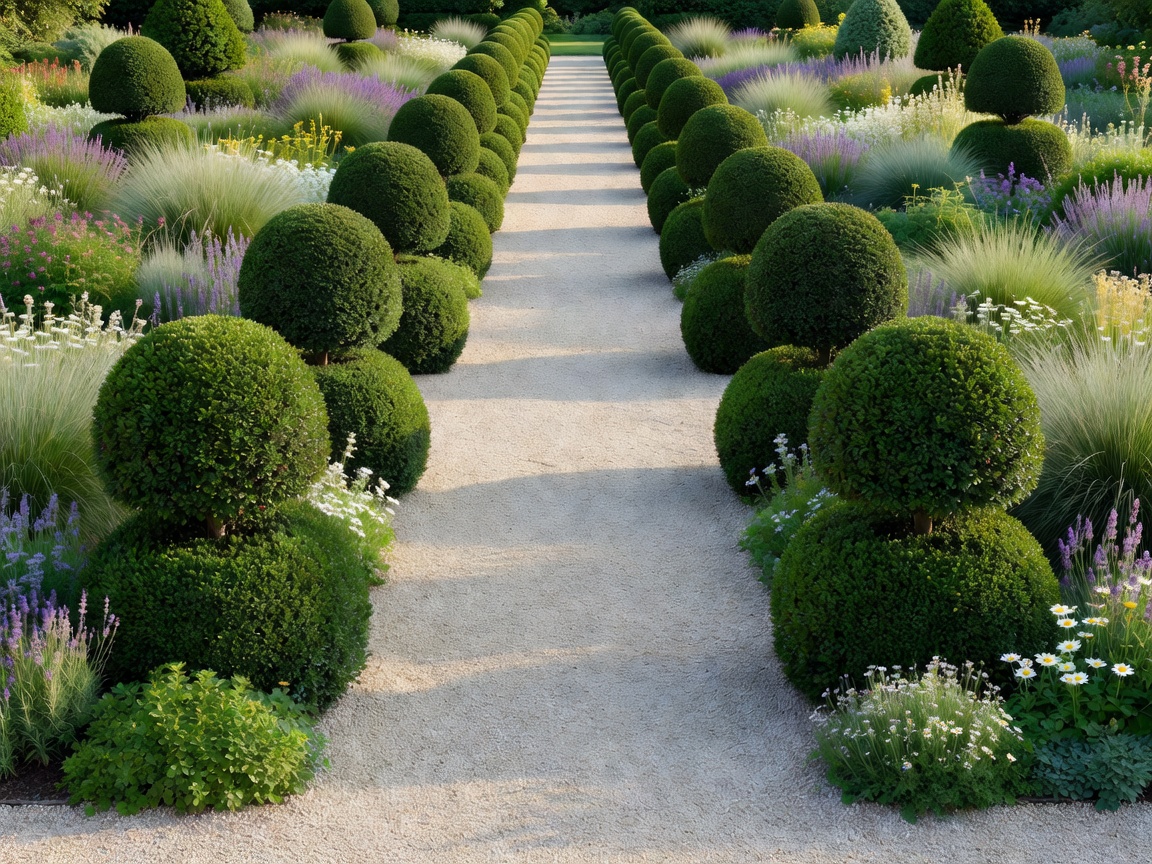
Separate exact symmetry from visual balance
Two equal beds placed at equal distances from an axis are geometrically symmetrical. A large airy grass on one side and a compact dark shrub on the other are not. They may still feel balanced because visual weight depends on colour, density, height and texture as well as footprint.
This distinction is useful rather than inconvenient. Exact symmetry can organise paving and bed boundaries while planting varies with conditions. You can repeat a rounded form, a flowering season or a foliage tone without pretending the planting is a mirror image. State which layer carries the symmetry so later changes do not dismantle the whole idea.
Repeat with mature growth in mind
Young plants can make almost any spacing look generous. Before setting them out, draw their expected mature spread under your conditions. Allow for the difference between naturally grown size and a size maintained by clipping. The second is a recurring maintenance commitment, not a permanent property of the plant.
Planting centres are not the same as clear gaps. If two shrubs each have a mature spread of one metre and their centres are one metre apart, their projected canopies meet. That simple relationship helps expose a common mistake: measuring attractive intervals between small pots while ignoring the foliage that will fill them.
Keep growth away from narrow routes, door swings and sightlines. Where a bed borders a path, reserve enough space that foliage does not routinely reduce the usable width. Seasonal leaning, wet stems and snow load can all make the apparent edge different from the drawn one.
Let the two sides have different needs
A wall may shade one bed while reflected heat dries the other. Repeating an unsuitable species will not overcome that difference. Instead, match plant performance to each position, then seek comparable height, mass or rhythm. A balanced composition can be honest about unequal conditions.
Repeated planting also concentrates risk. A disease affecting one species can remove an entire visual framework. Consider whether a mixed structural palette would retain the design if one component failed. If you use a long clipped run, plan how an individual replacement could be established without rebuilding the whole border.
Set out an orderly framework
- Mark the principal axis from fixed, recoverable reference points.
- Measure perpendicular offsets to corresponding bed corners or planting centres.
- Check the overall pattern from the main viewing positions, not only from above.
- Walk the working routes around the repeated elements before installing edges.
Rotational symmetry is another option: elements repeat around a centre rather than across a mirror line. It can organise a circular court, but radial wedges often narrow toward the middle. Check whether each wedge remains useful for planting, reaching and irrigation.
Learn from formal gardens without copying their workload
André Le Nôtre’s work at Versailles demonstrates long axes, controlled views and repeated forms at an extraordinary scale. The gardens at Villandry show how compartmentalised beds can make planting read as a larger pattern. Neither precedent tells you how much clipping time your own household has available.
For a smaller plot, borrow one clear relationship: paired entrance markers, a central opening or repeated bed widths. A restrained framework can survive relaxed planting and seasonal change. The aim is not to keep every leaf symmetrical, but to make the garden’s organisation remain understandable as it grows.