Give the centre a purpose
A seat, a specimen tree or a low water bowl can make the inward journey feel worthwhile. Decide whether people should reach the centre, look into it or move around it. These are different briefs. A planted centre needs maintenance access; a public gathering point needs enough room for arrival, passing and turning.
Before choosing materials, walk a temporary version using a hose or rope. Try it with the tools you actually use. If a wheelbarrow must be reversed through several tight bends, the route is asking for daily effort that an overhead drawing conceals. A short connecting opening may be more useful than preserving an unbroken spiral.
Set out both edges
- Locate the centre. Establish a reference point that can be recovered after the first excavation. Check boundary ownership and buried services before driving stakes.
- Mark the intended journey. Use temporary materials to show entry, route and destination. Keep the approach from the house legible.
- Add the path width. Draw both edges and check the narrowest clear space, including the inside of each bend. Account for future overhanging growth.
- Test the surrounding beds. Confirm that planting areas can be reached without standing on soil or blocking the route.
Let planting support the line
Low, repeated planting can reveal a curve without demanding a continuous clipped hedge. Choose plants for the site’s soil, exposure and available water before considering their outline. A sun-loving plant on one side and a shade-tolerant equivalent on the other may create a more durable rhythm than insisting on one species throughout.
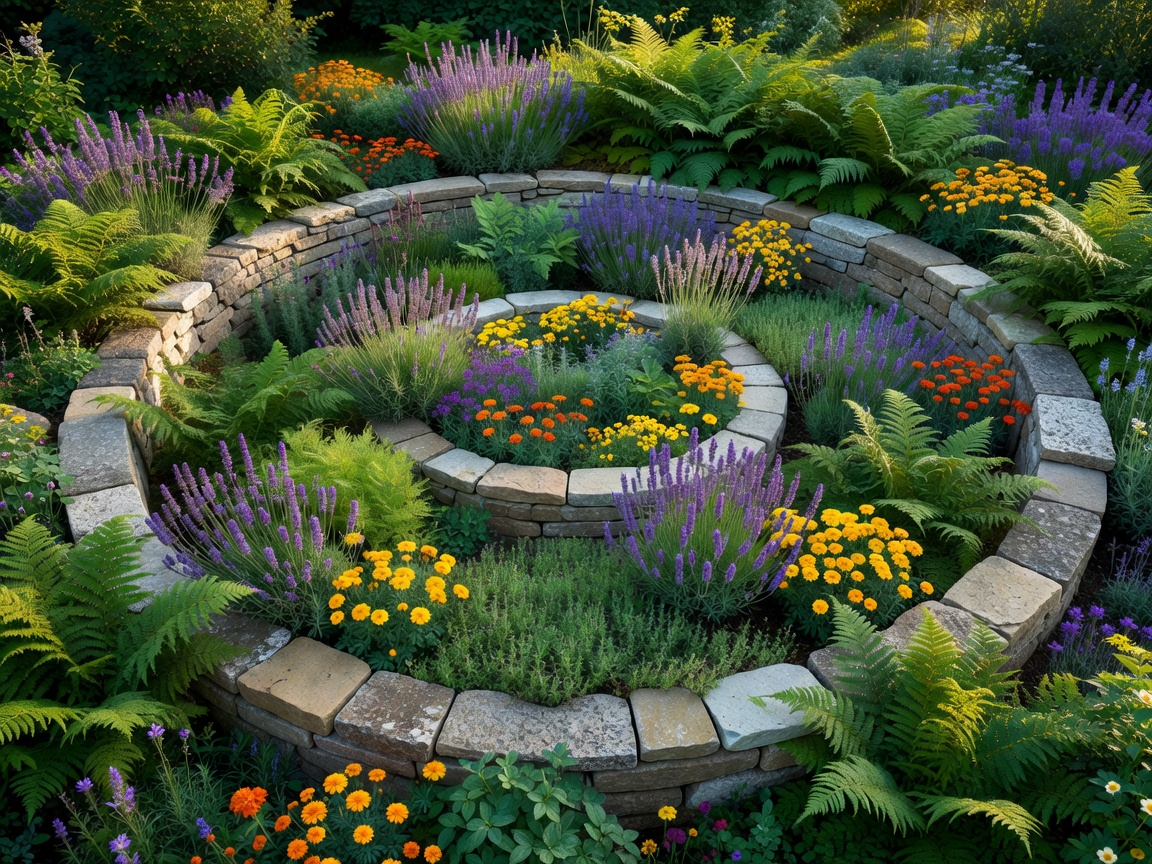
A raised herb spiral is a separate construction problem. Its height, retained soil, drainage and stone stability must be considered together. Elevation may create different moisture conditions, but it does not guarantee a predictable set of microclimates. Observe how water moves and how much sun each planting pocket actually receives.
Account for water, access and upkeep
Curved edging can interrupt surface runoff, especially where a path crosses a slope. Establish drainage and safe gradients before making the spiral permanent. Loose gravel may move on an incline and can be difficult for some wheels and walking aids. A firm, stable surface may be more appropriate, depending on users and local requirements.
Clipped edges require repeated cutting, collection and replacement. A planted line needs weeding and occasional division. Leave a route for this work, and keep drains and inspection covers reachable. Seasonal dieback can make a planted spiral disappear; a restrained hard edge can retain the structure without turning every border into masonry.
Use precedents carefully
The Garden of Cosmic Speculation, associated with Charles Jencks and Maggie Keswick Jencks, shows how landform can evoke scientific ideas at landscape scale. It is inspiration, not a template for a domestic plot. At a smaller scale, the useful lesson is to connect form with a clear experience rather than copy a dramatic aerial silhouette.
A successful spiral might be incomplete, gently distorted or interrupted by a practical crossing. If the revised curve supports comfortable movement and healthy planting, mathematical purity has not been lost by accident: it has been traded consciously for a better garden.